
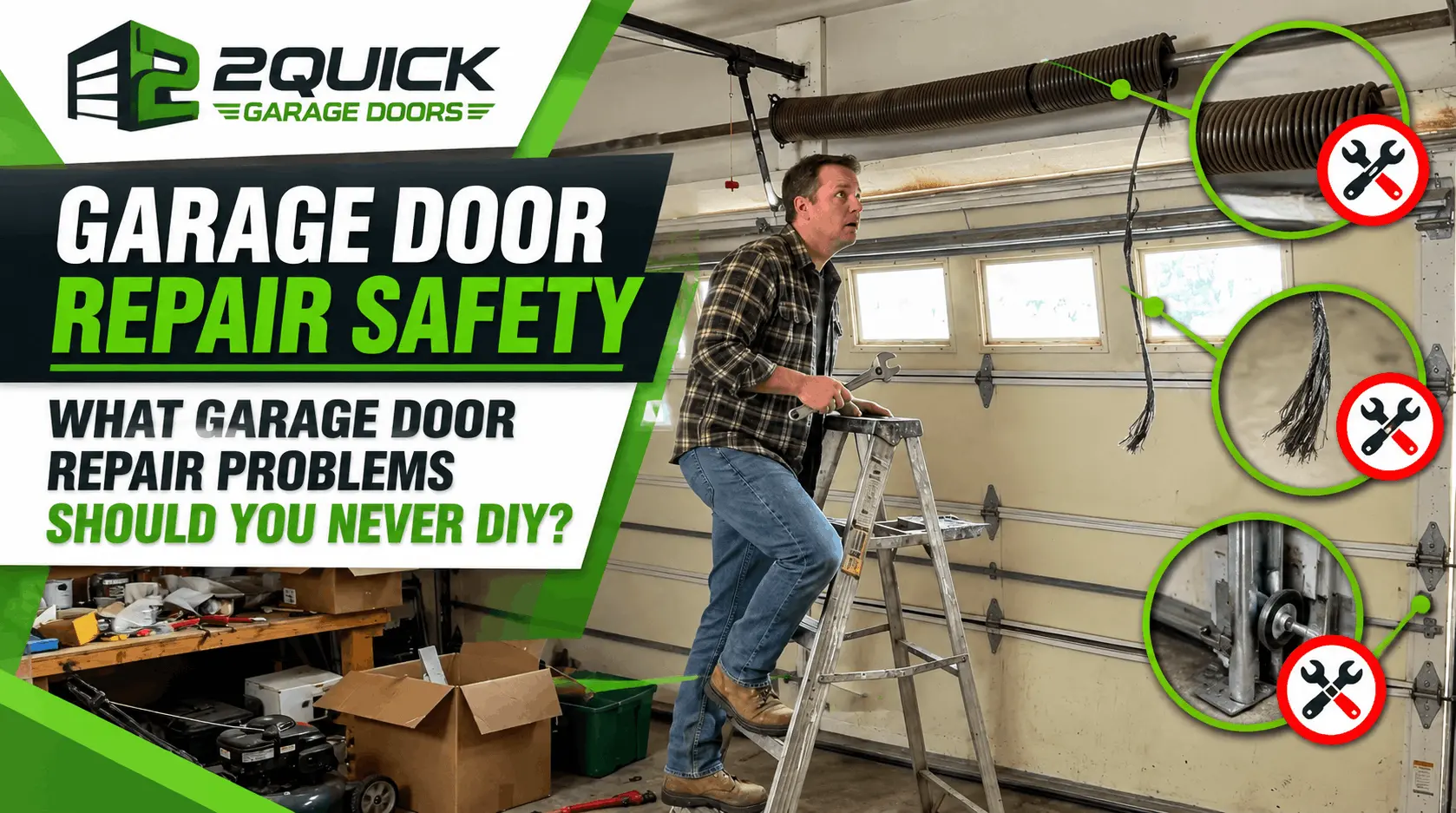
Garage Door Repair Safety: What Garage Door Repair Problems Should You Never DIY?
Garage doors may look straightforward, but many of their components operate under significant tension and carry substantial weight. A problem that appears simple can quickly become a serious safety issue if the wrong component is adjusted, removed, or repaired.
Understanding garage door repair safety helps homeowners and property managers recognize which problems can be inspected safely and which require professional attention.
Some minor checks, such as clearing an obstruction or inspecting visible safety sensors, may be reasonable for a property owner. However, problems involving springs, cables, brackets, tracks, or other high-tension components should not be treated as ordinary DIY projects.
This guide explains the most common garage door repair problems that should not be handled without the proper experience and equipment.
Why Is Garage Door Repair Safety So Important?
A garage door can weigh hundreds of pounds, while its spring system is designed to counterbalance that weight during opening and closing. When the system is working correctly, the door can move smoothly and predictably.
When a component fails, however, the stored energy and weight involved can create serious garage door repair hazards.
A mistake during an adjustment or repair can result in:
- A garage door falling unexpectedly
- Springs releasing stored tension
- Cables snapping or coming loose
- Fingers becoming trapped between moving components
- Tracks or brackets shifting unexpectedly
- Damage to the garage door opener
- Additional damage to the door itself
That is why garage door safety should always come before attempting to save time by performing a repair yourself.
What Garage Door Repairs Should You Never DIY?
Not every garage door issue requires a technician. However, several repairs involve components that should be handled by trained professionals.
1. Broken or Damaged Garage Door Springs
Garage door springs are among the most important components to treat with caution.
Both torsion springs and extension springs store a considerable amount of energy. When a spring breaks, the door may become extremely heavy and difficult to move.
A broken garage door spring may cause symptoms such as:
- The door will not open
- The opener struggles to lift the door
- The door opens only a few inches
- The door closes too quickly
- A visible spring has separated or snapped
- The door feels unusually heavy when operated manually
Replacing a spring is not a simple matter of removing the old part and installing a new one. Spring type, size, tension, door weight, and system configuration all matter.
For this reason, spring replacement should be left to professional garage door repair technicians with the appropriate tools and experience.
2. Garage Door Cable Repair
Garage door cables work together with the spring system to help lift and balance the door.
If a cable becomes loose, frayed, disconnected, or broken, the door may become uneven or move unpredictably.
A broken garage door cable should not simply be pulled, reattached, or wrapped back around the drum without understanding why it came off in the first place.
Cable problems can also be connected to:
- Spring failure
- Poor garage door balance
- Damaged drums
- Track problems
- Door misalignment
- Excessive tension
Trying to repair these components without proper knowledge can create additional garage door repair hazards.
3. Garage Door Off-Track Problems
An off-track garage door can look like a straightforward alignment issue, but the cause may be more complicated.
A door can come off its tracks because of:
- Damaged rollers
- Bent tracks
- Broken cables
- Impact damage
- Spring problems
- Door imbalance
- Loose hardware
Attempting to force the rollers back into the tracks while the door is under tension can be dangerous.
If the door is visibly leaning, partially detached, or hanging unevenly, avoid operating it until the cause has been properly inspected.
4. Spring Brackets and High-Tension Hardware
Spring-related brackets and other high-tension components should not be adjusted casually.
These parts help hold and control the spring system. Removing or loosening the wrong hardware can release stored energy unexpectedly.
This is one of the biggest reasons why safe garage door repair requires more than simply following a generic online tutorial.
If the repair involves spring tension, winding components, drums, cables, or spring brackets, professional service is the safer option.
5. Garage Door Bottom Bracket Replacement
Bottom brackets connect the garage door cables to the lower portion of the door.
They may appear small, but they can be connected to a cable system under significant tension.
Replacing a bottom bracket without properly securing and understanding the cable system can result in sudden movement or cable release.
This is another repair where DIY garage door repair can create more risk than benefit.
6. Major Garage Door Track Repairs
Garage door tracks guide the rollers as the door opens and closes.
A slightly loose fastener may appear simple, but major track problems are different.
Bent, damaged, severely misaligned, or improperly positioned tracks can affect the entire movement of the door.
A technician may need to inspect the:
- Tracks
- Rollers
- Hinges
- Cables
- Springs
- Door alignment
- Mounting hardware
If the track has been significantly bent or displaced, avoid trying to force it back into position.
7. Garage Door Panel Repairs That Affect the Door Structure
Minor cosmetic damage may not always require immediate professional attention. However, a severely damaged panel can affect the structure and balance of the entire door.
This becomes especially important when damage occurs around:
- Hinges
- Roller mounts
- Brackets
- Bottom sections
- Connections between door sections
A damaged panel should be evaluated before attempting a repair that could affect the door’s movement or balance.
8. Garage Door Opener Repairs Involving Electrical Components
The garage door opener contains electrical and mechanical components that require caution.
If the opener is making unusual noises, repeatedly shutting off, showing electrical symptoms, or has damaged wiring, avoid opening electrical components unless you have the appropriate qualifications.
Some basic opener troubleshooting can be performed safely, such as checking the remote batteries or confirming that the opener is receiving power.
However, internal electrical repairs should be handled by a qualified professional.
9. Safety Sensor Problems: What Can You Check Yourself?
Safety sensors are one area where a property owner can perform some basic visual checks.
You can inspect whether:
- Something is blocking the sensors
- The sensor lenses are dirty
- The sensors appear visibly misaligned
- Objects are placed between the sensors
- The sensor brackets appear loose
However, if the sensors continue to malfunction after basic checks, the problem may involve wiring, the opener, or the sensor system itself. Do not bypass the safety sensors simply to make the door operate.
10. Garage Door Balance and Spring Adjustment
A properly balanced garage door should not feel excessively heavy or drop rapidly when manually operated.
If the door is difficult to lift or behaves unevenly, the problem could involve the spring system.
That does not mean the solution is to adjust the spring yourself.
Garage door balance depends heavily on the correct spring tension. Incorrect adjustment can damage the door and create a dangerous situation.
What Garage Door Problems Can You Safely Check Yourself?
There are several basic inspections that may be appropriate for property owners.
For example, you can visually inspect:
- Obstructions around the door
- Safety sensor alignment
- Remote-control batteries
- Visible damage to the door
- Loose debris around tracks
- Unusual noises
- Obvious gaps or damaged weather seals
- Whether the opener has power
These checks can help you understand what is happening without directly manipulating high-tension components.
The key difference is between inspection and repair. If you can identify a potential problem without touching a dangerous component, that is generally safer than attempting to repair the component yourself.
Garage Door Repair Safety Tips for Homeowners
Following a few basic garage door repair safety tips can help reduce unnecessary risks.
Keep people away from a damaged door
If a door is hanging unevenly, has a broken spring, or appears unstable, keep children, pets, employees, and visitors away from the area.
Do not repeatedly operate a malfunctioning door
Continuing to run an opener when the door is damaged can make the original problem worse.
Never bypass safety sensors
Safety features are designed to reduce the risk of the door closing when something is in its path.
Do not adjust springs without proper knowledge
Spring adjustment is one of the areas where an incorrect DIY repair can become particularly dangerous.
Do not force an off-track door
If the door is off its tracks, forcing it open or closed may damage additional components.
Keep the area around the garage door clear
Storage, vehicles, tools, and other objects should not interfere with the door’s movement.
These simple habits support better overall garage door safety.
When Should You Stop Using the Garage Door?
Stop operating the door if you notice signs that suggest a potentially serious mechanical problem.
Examples include:
- A broken spring
- A broken or loose cable
- The door is hanging at an angle
- The door has come off the tracks
- A panel is severely damaged
- The door suddenly becomes extremely heavy
- The opener struggles or repeatedly stops
- The door slams down
- The door moves unpredictably
- You hear loud popping or snapping sounds
When any of these symptoms occur, continuing to operate the door may increase the damage. Instead, have the system inspected before using it again.
Common Garage Door Repair Hazards to Avoid
Many problems happen because a repair seems easier than it actually is.
Some common garage door repair hazards include attempting to:
- Wind or unwind torsion springs
- Stretch extension springs
- Reattach tensioned cables
- Replace bottom brackets
- Force rollers into severely damaged tracks
- Remove spring hardware
- Lift a heavy door manually without understanding its condition
- Disable safety sensors
- Continue using an opener with a mechanically damaged door
The safest approach is to identify the symptom without interfering with components that store or control mechanical energy.
DIY Garage Door Repair vs. Professional Garage Door Repair
There is a difference between basic troubleshooting and mechanical repair.
Simple checks may help you identify a problem, but repairs involving springs, cables, brackets, major track damage, or structural components require a higher level of expertise.
DIY garage door repair may be reasonable for simple maintenance or visual checks. More complicated repairs should be handled by professional garage door repair technicians.
If you are searching for garage door repair near me, look for a qualified local company that can inspect the complete system rather than replacing only the visibly damaged component.
A proper inspection can reveal whether the underlying problem involves the springs, cables, tracks, rollers, hinges, opener, or door balance.
Garage Door Repair Safety for Residential and Commercial Properties
Garage door safety is important for both residential and commercial properties.
A residential garage door may be used several times each day, while a commercial garage door may experience significantly higher operating cycles depending on the property and application.
Commercial doors can also be larger and heavier, making mechanical problems particularly important to address promptly.
For either type of property, regular inspection can help identify worn components before they become major repair problems.
A garage door safety inspection can include an assessment of:
- Springs
- Cables
- Rollers
- Hinges
- Tracks
- Brackets
- Door balance
- Opener operation
- Safety sensors
- Visible structural damage
What Should You Do Before a Garage Door Technician Arrives?
If you have identified a serious garage door problem, there are a few things you can do while waiting for service.
First, keep people away from the affected area. If possible, leave the garage door in its current position rather than repeatedly attempting to operate it.
Do not remove springs, cables, brackets, or other mechanical components.
You can also take a photo or video of the problem from a safe distance. This may help explain the symptoms to the technician.
If the door is partially open or unstable, do not attempt to manually lift or lower it unless a professional has specifically instructed you to do so.
How Regular Garage Door Maintenance Can Improve Safety
Regular maintenance can help identify wear before a component fails unexpectedly.
A maintenance inspection can include checking:
- Springs
- Cables
- Rollers
- Hinges
- Tracks
- Fasteners
- Safety sensors
- Opener operation
- Door balance
- Weather seals
Maintenance does not eliminate every possible failure, but it can help identify components that are worn, damaged, or operating incorrectly.
You can learn more about routine garage door maintenance services and the types of components that should be checked regularly.
Garage Door Repair Safety in The Woodlands, TX
Garage doors in The Woodlands, TX properties deal with regular daily use and exposure to changing weather conditions. Over time, components such as springs, rollers, cables, hinges, and weather seals can wear.
When a garage door begins behaving differently, it is better to identify the cause early instead of continuing to operate it until a small issue becomes a larger repair.
If the problem involves a broken spring, damaged cable, off-track door, major track issue, or another high-tension component, professional inspection is the safer approach.
When Is a Garage Door Problem an Emergency?
Not every garage door issue requires immediate service, but some situations deserve urgent attention.
Consider a prompt inspection if:
- The door is stuck open and cannot be secured
- A spring has broken
- A cable has snapped
- The door has fallen off its tracks
- The door is hanging dangerously
- The door is severely damaged
- The opener is operating while the door is mechanically unstable
- The door presents an immediate safety risk
If the garage door cannot be operated safely, stop using it until the problem has been evaluated.
Final Thoughts
Understanding garage door repair safety is just as important as understanding how the garage door works.
Some basic inspections and maintenance tasks can be handled by property owners, but repairs involving springs, cables, bottom brackets, major track problems, and other high-tension components should not be treated as ordinary DIY projects.
When you notice unusual movement, excessive noise, imbalance, visible damage, or a door that suddenly stops working correctly, focus on keeping the area safe and identifying the symptoms rather than attempting a risky repair.
For serious garage door repair problems, professional inspection can help determine the actual cause and prevent additional damage.
Frequently Asked Questions
1. What garage door repairs should never be DIY?
Repairs involving torsion springs, extension springs, tensioned cables, bottom brackets, major track damage, and other high-tension components should generally be handled by trained professionals.
2. Is DIY garage door repair safe?
Some basic inspections and maintenance tasks can be performed safely, but repairs involving high-tension or structural components can be dangerous without the correct knowledge and equipment.
3. How can I improve garage door safety?
Keep the door’s operating area clear, inspect safety sensors, avoid using a visibly damaged door, schedule regular maintenance, and have serious mechanical problems professionally inspected.
4. When should I call for professional garage door repair?
Call for professional service when the door has a broken spring or cable, comes off its tracks, becomes severely unbalanced, makes unusual mechanical noises, or has another problem that you cannot safely identify or correct.
5. Should I keep using my garage door if something is wrong?
It depends on the problem, but you should stop using the door if it is unstable, hanging unevenly, off its tracks, has a broken spring or cable, or presents an obvious safety risk.