
What Are the Most Common Garage Door Repair Problems?
A garage door can continue working normally for years, but its moving parts experience repeated cycles of use. Springs, rollers, cables, tracks, hinges, safety sensors, and the opener all have specific jobs, so a problem with one component can affect the way the entire door operates. These are some of the common garage door repair problems that residential and commercial property owners may encounter.
The important thing is not just recognizing that something is wrong. Understanding the common garage door repair problems behind these symptoms can help you decide whether a simple inspection is appropriate or whether the garage door should be taken out of service until a professional can inspect it.
Common garage door repair problems can begin with noticeable symptoms such as unusual noise, slow movement, uneven operation, or a door that stops before reaching the floor. Others can appear suddenly, such as a broken spring, damaged cable, or opener failure
Below are the problems garage door owners should know how to recognize and what each one can indicate.
1. The Garage Door Will Not Open or Close
One of the most noticeable garage door problems is a door that refuses to move.
Sometimes the cause is relatively simple. The opener may have lost power, the remote battery may be depleted, or the wall control may not be responding. A disengaged trolley or an obstruction can also prevent normal operation.
However, a door that will not move can also indicate a mechanical problem.
A broken spring, damaged cable, obstructed track, failed opener component, or severe door imbalance can prevent the system from operating correctly.
What to check safely
Before assuming a major failure, you can check whether:
- The opener has power.
- The remote has a working battery.
- The wall control responds.
- Anything is visibly blocking the door.
- The emergency release has been pulled accidentally.
If these basic checks do not identify the problem, avoid repeatedly activating the opener. Continued operation can place additional stress on the opener or other components.
2. A Broken Garage Door Spring
Garage door springs counterbalance the weight of the door. When a spring breaks or loses its ability to provide the required tension, the door can become extremely difficult or impossible to lift.
A broken spring may be accompanied by:
- A loud bang from the garage
- A visible separation in the spring coil
- A door that suddenly feels much heavier
- A door that opens only a few inches
- An opener that struggles to lift the door
Springs are under significant tension, which makes spring adjustment and replacement a job for a trained technician rather than a routine DIY repair.
If you notice a broken spring, do not try to compensate by increasing the opener’s force setting. The opener is designed to operate a properly balanced door, not to overcome a failed counterbalance system.
If spring problems are suspected, 2Quick’s garage door spring repair and replacement service is the appropriate service area to reference.
3. Frayed, Loose, or Broken Garage Door Cables
Lift cables work with the spring system to help raise and lower the garage door. A cable that becomes frayed, loose, or disconnected can cause the door to become uneven or stop moving correctly.
You may notice:
- One side of the door sitting higher than the other
- A loose cable near the bottom bracket
- The door hanging crooked
- The cable coming off the drum
- Grinding or unusual movement while the door operates
Cable problems should not be treated like a loose household wire. Garage door cables are connected to components that operate under substantial mechanical force.
If a cable has come off or snapped, avoid pulling or repositioning it yourself. Operating the door in that condition can create additional damage.
4. The Garage Door Is Off Track
A sectional garage door relies on tracks and rollers to control its movement. If a roller leaves the track or the track becomes bent or obstructed, the door may move unevenly or become stuck.
An off-track door can appear:
- Crooked in the opening
- Partially open
- Tilted on one side
- Stuck during movement
- Separated from the normal track path
This problem can sometimes happen after impact from a vehicle, but worn rollers, loose hardware, cable problems, or other mechanical issues can also contribute.
Do not force an off-track door back into position. The weight of the door and tension in connected components can make an improper adjustment dangerous.
5. Worn or Damaged Garage Door Rollers
Rollers allow the door sections to travel through the tracks. As they wear, the door may become louder or less smooth during operation.
Common signs include:
- Squeaking
- Grinding
- Rattling
- Jerky movement
- Visible roller wear
- Increased vibration
Not every noisy garage door needs a major repair. Sometimes the issue is related to lubrication or hardware, while worn rollers may need replacement.
The important distinction is whether the noise is new, progressively louder, or accompanied by changes in the way the door moves.
That combination deserves closer inspection.
6. Misaligned, Bent, or Obstructed Tracks
Garage door tracks guide the rollers along a controlled path. They need to remain properly positioned for the door to move smoothly.
A track problem can cause:
- Binding
- Scraping
- Jerky movement
- The door stopping at a particular point
- Uneven movement between sections
Inspect the visible track area for obvious objects or debris, but avoid trying to bend a damaged track back into place.
A track that looks slightly out of position may have a deeper mechanical cause. For example, a roller, hinge, cable, or impact could have contributed to the problem.
7. The Garage Door Reverses or Will Not Close
A door that begins closing and then reverses is often responding to its safety system.
Modern garage door openers use photo-eye safety sensors near the floor. If the sensors are blocked, dirty, misaligned, or experiencing another fault, the opener may prevent the door from closing normally.
Start by checking for obvious obstructions around the sensor area and make sure nothing is physically blocking the door.
However, don’t bypass the safety system simply to make the door close.
If the door repeatedly reverses despite clear sensor areas, the issue may involve sensor alignment, wiring, travel settings, the opener, or another mechanical problem.
8. The Garage Door Opener Stops Working
Sometimes the door itself is mechanically fine but the opener cannot operate it correctly.
Opener problems can include:
- Motor failure
- Worn internal components
- Electrical problems
- Remote-control issues
- Wall-control problems
- Drive-system problems
- Incorrect travel settings
- Safety sensor faults
One useful observation is whether the opener runs but the door does not move.
If you hear the motor operating without normal door movement, the problem may involve the connection between the opener and the door rather than simply a power issue.
For more serious opener symptoms, professional diagnosis is preferable to repeatedly adjusting settings without identifying the underlying cause.
You can see the dedicated garage door opener repair and installation services for this type of issue.
9. The Garage Door Makes Unusual Noises
A garage door does not need to be completely silent, but a new or noticeably louder sound deserves attention.
Different sounds can point toward different problems.
Grinding may indicate worn rollers, track problems, or another component creating excessive friction.
Squeaking can occur when moving components require maintenance or when parts are beginning to wear.
Rattling may be associated with loose hardware, panels, or other components vibrating during operation.
A loud bang can be a warning sign of a broken spring.
The sound alone does not provide a definite diagnosis. Instead, treat it as a signal to inspect the door and determine whether its movement has also changed.
10. The Garage Door Is Uneven or Unbalanced
A properly functioning garage door should move in a controlled and relatively consistent manner.
If one side rises higher than the other, the door appears crooked, or it becomes unusually heavy when operated manually, there may be an issue with the spring system, cables, rollers, tracks, or another component.
An unbalanced door can also put unnecessary strain on the opener.
This is particularly important because replacing or adjusting one component without addressing the underlying balance problem may not resolve the issue.
A professional inspection can determine whether the problem is related to the door’s counterbalance system, hardware, or alignment.
11. Damaged Garage Door Panels
Garage door panels can become damaged through vehicle impact, weather exposure, age, or other physical events.
Panel damage can range from a small dent to a section that is cracked, bent, or structurally compromised.
Not every dent requires replacing the entire garage door.
The right decision depends on:
- The extent of the damage
- Whether the panel affects door movement
- Whether the track or rollers were affected
- The condition and age of the remaining door
- Whether replacement parts are available
A professional assessment can help determine whether panel repair, panel replacement, or a complete door replacement makes the most sense.
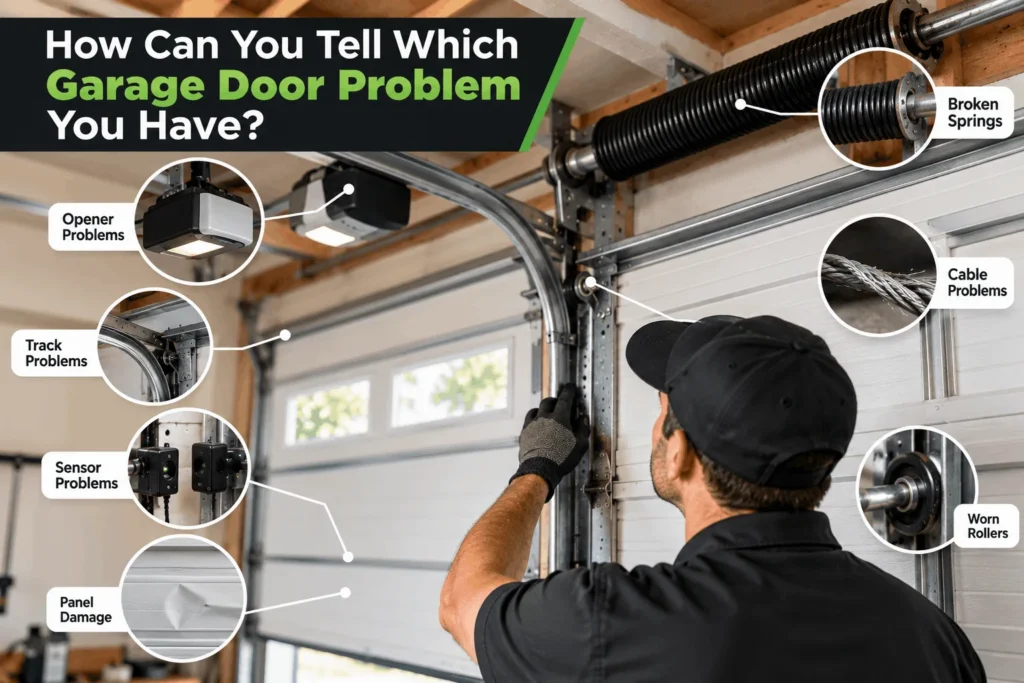
How Can You Tell Which Garage Door Problem You Have?
The easiest starting point is to focus on what the door is doing, rather than immediately assuming which component has failed.
| What you notice | Possible causes |
|---|---|
| Door will not open | Spring, opener, cable, power, track |
| Door will not close | Sensors, obstruction, opener, travel settings |
| Door reverses | Safety sensors, obstruction, opener settings |
| Door is very noisy | Rollers, hinges, tracks, hardware |
| Door hangs crooked | Cable, spring, roller, track |
| Door feels unusually heavy | Broken or weakened spring |
| Door moves unevenly | Track, roller, cable, spring |
| Motor runs but door does not move | Opener drive system or connection |
| Door is off track | Roller, track, cable, impact |
| Visible cable damage | Cable or related counterbalance issue |
This symptom-first approach is useful because the same symptom can have several possible causes.
For example, a garage door that will not close could involve a sensor problem, an obstruction, an opener issue, incorrect settings, or a mechanical fault. Replacing a random component without diagnosing the cause can leave the original problem unresolved.
Which Garage Door Problems Are Safe to Check Yourself?
There are a few basic observations most property owners can make without disassembling the garage door system.
You can safely check for:
- Obvious objects blocking the door
- Debris around the sensor area
- Whether the opener has power
- Remote-control battery condition
- Visible damage to panels
- Obvious track obstructions
- Unusual sounds or changes in door movement
The important boundary is observation versus mechanical repair.
Do not attempt to adjust torsion springs, extension springs, lift cables, bottom brackets, or other components under significant tension unless you have the appropriate training and equipment.
Garage doors are heavy mechanical systems. A repair that appears simple can become hazardous when tensioned components are involved.
When Is a Garage Door Problem an Emergency?
Not every garage door issue requires immediate service, but some conditions should not be ignored.
Consider professional attention promptly if:
- The door is stuck open
- A spring has broken
- A lift cable has snapped or come loose
- The door is severely off track
- The door is hanging unevenly
- A panel or hardware has suffered significant impact damage
- The door could fall or move unexpectedly
- The opener is repeatedly operating against a mechanical problem
A garage door that is stuck open can also create a security concern for a residential property or interrupt access to a commercial facility.
If the door appears unsafe, avoid repeated attempts to operate it until the problem has been evaluated.
Residential and Commercial Garage Door Problems
The underlying mechanical problems can be similar in residential and commercial garage door systems, but the operating requirements can differ.
A residential garage door may experience repeated daily cycles from vehicle access and routine household use.
A commercial garage door may have substantially higher usage depending on the facility and its operating schedule. Downtime can also interfere with deliveries, employee access, inventory movement, or customer operations.
For that reason, commercial garage door problems should be evaluated based not only on the immediate symptom but also on how the door is used and how quickly normal operation needs to be restored.
The same principle applies to residential systems: a minor symptom should not be ignored simply because the door still works.
How to Prevent Common Garage Door Problems
You cannot prevent every component from eventually wearing out, but routine attention can help identify developing problems earlier.
Pay attention to changes in operation
If your garage door suddenly becomes louder, slower, rougher, or less consistent, investigate the change rather than waiting for complete failure.
Keep the door and tracks clear
Objects near the door’s travel path can interfere with movement and create unnecessary strain.
Watch for visible wear
Check for obvious damage to rollers, cables, panels, tracks, and other accessible components without attempting to disassemble them.
Schedule routine maintenance
Professional maintenance can help identify worn components, alignment issues, lubrication needs, and other developing problems before they become more disruptive.
2Quick also provides garage door maintenance services for ongoing system care.
Should You Repair or Replace a Garage Door?
A garage door problem does not automatically mean the entire system needs replacement.
Repair may be appropriate when the door itself is structurally sound and the problem is isolated to a component such as a spring, cable, roller, sensor, opener, or another repairable part.
Replacement may become more appropriate when the door has extensive structural damage, repeated major failures, significant deterioration, or compatibility issues with older components.
The best decision depends on the actual condition of the door rather than a single symptom.
A professional inspection can help determine whether repairing the existing system or replacing it is the more appropriate long-term solution.
Common Garage Door Problems FAQs
What is the most common garage door problem?
Common issues include broken springs, opener problems, sensor faults, worn rollers, cable problems, track issues, unusual noise, and doors that will not open or close properly. The exact cause depends on the symptoms and condition of the individual door.
Why is my garage door suddenly not working?
A garage door can stop working because of a power or control issue, broken spring, damaged cable, opener failure, sensor problem, track obstruction, or another mechanical fault. Start with simple visual checks and avoid forcing the door if it appears damaged.
How do I know if my garage door needs repair?
New or worsening noise, slow or uneven movement, a crooked door, visible component damage, repeated reversing, difficulty opening or closing, or unusual heaviness can all indicate that the garage door needs professional attention.
Is it safe to repair a garage door myself?
Basic checks such as looking for obstructions, checking power, and inspecting accessible areas are generally reasonable. Repairs involving springs, cables, brackets, or other high-tension components should be handled by a qualified garage door professional.
How often should a garage door be inspected?
There is no single inspection interval that fits every system because usage, age, environment, and component condition vary. Regular observation and professional maintenance can help identify wear before it develops into a major failure.
Final Thoughts
The most important thing about common garage door repair problems is recognizing that symptoms often appear before complete failure.
A strange noise, uneven movement, repeated reversal, visible cable wear, or a door that suddenly feels heavier should not simply be dismissed because the system still operates.
Some issues may be relatively straightforward, while problems involving springs, cables, tracks, or significant mechanical damage can create safety risks if handled incorrectly.
If you are dealing with a garage door that is no longer operating normally, identifying the symptom is a useful first step. The next step is determining whether the issue can be safely inspected or requires professional diagnosis and repair.
For property owners in the area, garage door repair in The Woodlands, TX provides a natural next step when a garage door problem needs professional attention.
One thought on “What Are the Most Common Garage Door Repair Problems?”
Pingback: Garage Door Repair Safety: What You Should Never DIY